
EmpCo Explained: A Reconsidered Primer on the New EU Green Claims Legislation
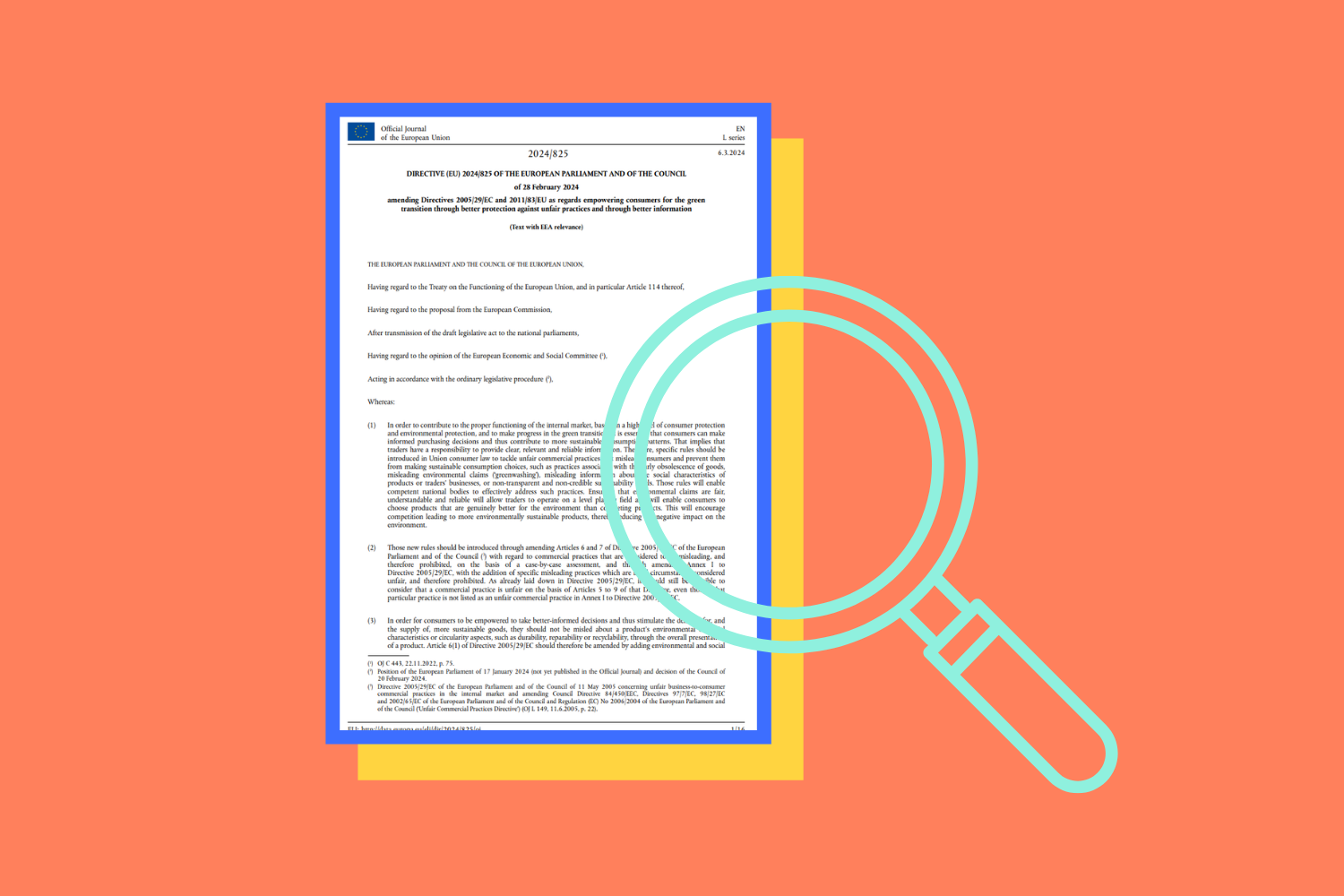
The days of sloppy sustainability communications are over. As of September 27, 2026, a new EU law called the Empowering Consumers for the Green Transition Directive (EmpCo) requires every social and environmental claim a company makes to consumers to be specific, provable and backed by real action.
EmpCo is an EU law, but its influence travels. Whether or not you fall under it directly, it's shaping how companies communicate sustainability to consumers, with ripple effects around the globe.
Yes, it's a big challenge. It's also a gift. For years, sustainability messaging has been a swamp of fuzzy words and leafy logos, confusing consumers and leading many of them to tune it all out. With EmpCo, companies doing the real work finally get to stand out. In our strategic communications work at Reconsidered, that's the part we find most exciting.
So what is EmpCo and what do you need to know about it? We’ve created a primer to walk you through the basics.
What is EmpCo?
EmpCo is short for the Empowering Consumers for the Green Transition Directive (you'll also see it called ECGT). Its official name is Directive (EU) 2024/825, and it was adopted on February 28, 2024. EU countries had until March 27, 2026, to write it into national law, and the rules have applied since September 27, 2026.
EmpCo doesn't start from scratch; rather, it updates the EU's existing rulebook on misleading marketing, the Unfair Commercial Practices Directive, which has protected shoppers since 2005. It also updates the Consumer Rights Directive, which sets out what shoppers must be told before they buy. Think of it as both laws getting a sustainability upgrade.
Because it's a directive, each EU country writes it into its own national law. The Netherlands, for example, put its version into force on the same September date. The details can vary a little by country, but the core rules are the same everywhere.
Who does EmpCo apply to?
EmpCo applies to any company making environmental or social claims to consumers in the EU. Where you're headquartered doesn't matter; if an EU shopper can see the claim, it counts.
And "claim" stretches further than most people expect, going beyond advertising and packaging to include:
Websites and product pages
Social media and campaigns
Sales and marketing materials
Sustainability reports, once their content gets reused in consumer-facing places
Visuals: colors, icons, badges, symbols and nature imagery can all count as claims
Names: brand, company and product names count too
What does EmpCo actually say?
The short version: say what you can prove, and prove what you say. Which, frankly, has been our advice to clients for years! But EmpCo does get quite a bit more specific; here’s a summary of the main points:
☁️ Vague green claims are out.
The directive's own examples include "environmentally friendly," "eco-friendly," "green," "nature's friend," "ecological," "environmentally correct," "climate friendly," "gentle on the environment," "carbon friendly," "energy efficient," "biodegradable" and "biobased." You can only use such claims if you can demonstrate recognized environmental performance that's relevant to the claim — such as the EU Ecolabel, an officially recognized national ecolabel (EN ISO 14024), or top performance under other EU law, like an A rating on the EU energy label. That evidence needs to sit clearly and prominently on the same pack, ad or web page; it’s not enough to link out to the details via a QR code or shortlink.
🌎 This applies to both social and environmental claims.
EmpCo adds environmental and social characteristics, plus circularity aspects like durability, repairability and recyclability, to the things companies must not mislead people about. Social claims can cover fair wages and working conditions, workplace safety, human rights, equal treatment and diversity, community initiatives and ethical commitments like animal welfare. Regulators judge these case by case.
🎨 Design is a claim too.
A claim can be words, pictures, graphics, symbols or labels, and it can live in a brand, company or product name. Spoken and video claims count. Even a modest line of text paired with green colors or nature imagery can add up to a generic claim.
🧩 Don't make whole-product claims about one part.
You can't make a claim about an entire product or business when it only applies to one piece. "Made with recycled material" doesn't fly if only the packaging is recycled, and neither does implying you run on renewables when some of your sites still use fossil fuels.
✅ Don't advertise what the law already requires.
You can't present something the law requires of every product in your category as a special feature. Advertising a product as free of a chemical that's already banned across the EU is out.
👻 Don't promote benefits unrelated to the product.
No bragging about perks that have nothing to do with the product's features, like gluten-free bottled water or plastic-free paper.
⚖️ Carbon-neutral claims can't rely on offsets.
Claims that a product has a neutral, reduced or positive climate impact can't rest on offsetting emissions outside its value chain. The directive names "climate neutral," "CO₂ neutral certified," "carbon positive," "climate net zero," "climate compensated," "reduced climate impact" and "limited CO₂ footprint." Claims like these are only allowed when based on the product's actual lifecycle impact. You can still talk about climate projects you invest in, including carbon credits, as long as it isn't misleading.
📋 Net zero and future targets need a verified plan.
Goals like "net zero by 2050" need clear, objective, public and verifiable commitments, set out in a detailed, realistic implementation plan with measurable, time-bound targets and the resources to deliver them, like budget and technology. An independent third-party expert, free of conflicts of interest, must check progress regularly, and their findings must be available to consumers.
📛 Only certified or official labels are allowed.
Sustainability labels, environmental or social, are only allowed if they're set by public authorities (like the EU Ecolabel or EMAS) or based on a certification scheme that:
is open to any company on fair, transparent terms
was developed with relevant experts and stakeholders
has clear consequences for non-compliance, including pulling the label
is monitored by an independent third party
↔️ Comparison claims must explain the method.
If you compare products on environmental, social or circularity grounds, tell people the method, which products and suppliers you're comparing and how you keep the information up to date.
🔨 Durability, repair and update claims must be accurate.
No false claims about how long or how hard a product can be used, like promising a washing machine will last a set number of cycles. No calling a product repairable when it isn't. No nudging people to replace consumables, like printer ink, before they need to. No hiding that a software update will make a product work worse, or calling an update necessary when it only adds features. And no hiding that non-original ink, chargers or parts will limit how a product works, or falsely claiming they will.
⏳ Products with built-in expiry dates can't be promoted.
Companies can't promote a product that contains a feature designed to limit its life, like software that downgrades it after a set time or a part designed to fail, once information about that feature is available to them.
💳 Sellers must share guarantee, repair and update info at checkout.
Where the producer makes the information available, sellers must tell consumers about:
The legal guarantee: a reminder of the minimum two-year legal guarantee, shown with a harmonized EU notice
Durability guarantees: a harmonized EU label whenever the producer offers a free guarantee covering the whole product for more than two years
Software updates: the minimum period free updates will be provided, for connected products, digital content and digital services
Repair: the product's EU reparability score where one exists, or otherwise information on spare parts (availability, cost and how to order), repair instructions and repair restrictions
Greener delivery: eco-friendly delivery options, like cargo bikes or electric vans, where available
Okay, but what does that look like in practice?
The fix is usually simple: swap sweeping statements for the specific facts behind them, or drop them altogether. Here’s a list of specific swaps, direct from the EmpCo regulation text:
"Climate-friendly packaging" → "100% of the energy used to make this packaging comes from renewable sources"
"Made with recycled material" (when only the packaging is) → "Packaging made from recycled material"
"We only use renewable energy" (when some sites still use fossil fuels) → "Fossil fuel use across our business fell by [X]% last year"
"Climate neutral," "CO₂ neutral certified" or "climate compensated" (based on offsets) → A claim based on the product's actual lifecycle impact, with any carbon credit projects described separately
"Energy efficient" (with nothing recognized behind it) → "Energy efficient," backed by an A rating on the EU energy label
"Free of [substance]" (when it's banned for all products in the EU) → Drop it: every product in the category already meets that bar
"Gluten-free" on bottled water, "plastic-free" on paper → Drop it: the benefit has nothing to do with the product
"Lasts [X] washing cycles" (when it doesn't under normal use) → A durability figure that holds up under the conditions in the instructions
What happens if you get it wrong?
Enforcement sits with national authorities, like the ACM in the Netherlands, and EmpCo gives them a much stronger basis to act on greenwashing. The consequences can include:
Fines set under the EU's existing consumer rules: for widespread infringements across EU countries, maximum fines must reach at least 4% of annual turnover in the countries concerned, or €2 million where turnover data isn't available
Corrective measures, like pulling or rewriting claims
Public naming and shaming
Civil claims from consumers or other parties
Then there's the cost no regulator sets: lost trust. Once people feel misled, winning them back takes far longer than getting the claim right the first time.
What should companies be doing to get their claims and systems up to speed?
The rules are already live, so the best time to start was… well, yesterday. But the second best is today! Here are a few next steps to get your house in order:
Take inventory. Gather every green claim, label, certification and visual you use, everywhere it shows up: packaging, website, social, sales decks, reports.
Collect and test the evidence. For each claim, ask: could we prove this tomorrow if someone asked? Organize your evidence and rewrite or retire anything vague, sweeping or shaky.
Set up a robust system of claims governance. Create a simple process for reviewing and approving claims, and get sustainability, comms, marketing, legal and product teams around the same table.
Pressure-test your future goals. Make sure targets like net zero come with milestones, a credible plan and independent verification.
Learn from similar cases. Study recent green claims lawsuits and regulator rulings in your sector. They show what kinds of claims actually get called out in practice, which makes your own blind spots much easier to spot.
Train your people. Non-compliance often starts small, with one hasty sentence in a social post. Give teams shared definitions and a clear sense of what's in and out.
I’m overwhelmed. Can Reconsidered help?
EmpCo is a lot to take in, and nobody needs to tackle it alone. At Reconsidered, we’ve been advising and training on green claims since 2014. Our goal is to help companies turn the regulatory burden of EmpCo into a meaningful opportunity for clearer, braver communications and brand building.
Specifically, we can help teams with:
Claims review, refinement and governance. We comb through your claims, labels and visuals and show you what to keep, fix or retire. We’ll also help you set up a seamless governance system to make future claims checks easy.
Broader communications strategy. We help you tell a specific, credible impact story that builds trust and drives action, whether that’s for external or internal audiences.
Team workshops. We lead compelling workshops that help get sustainability, marketing and legal teams on the same page and speaking the same language.
DIG DEEPER
〰️
DIG DEEPER 〰️
Our Signature Training: The Sustainability Communications Reset
We’re updating and evolving our signature Sustainability Communications Reset training for the post-EmpCo era. Learn more and get on our waitlist for the next session.
SOURCE: Directive (EU) 2024/825, Official Journal of the European Union, 6 March 2024